The urban failures on the foreign domestic helpers of Hong Kong
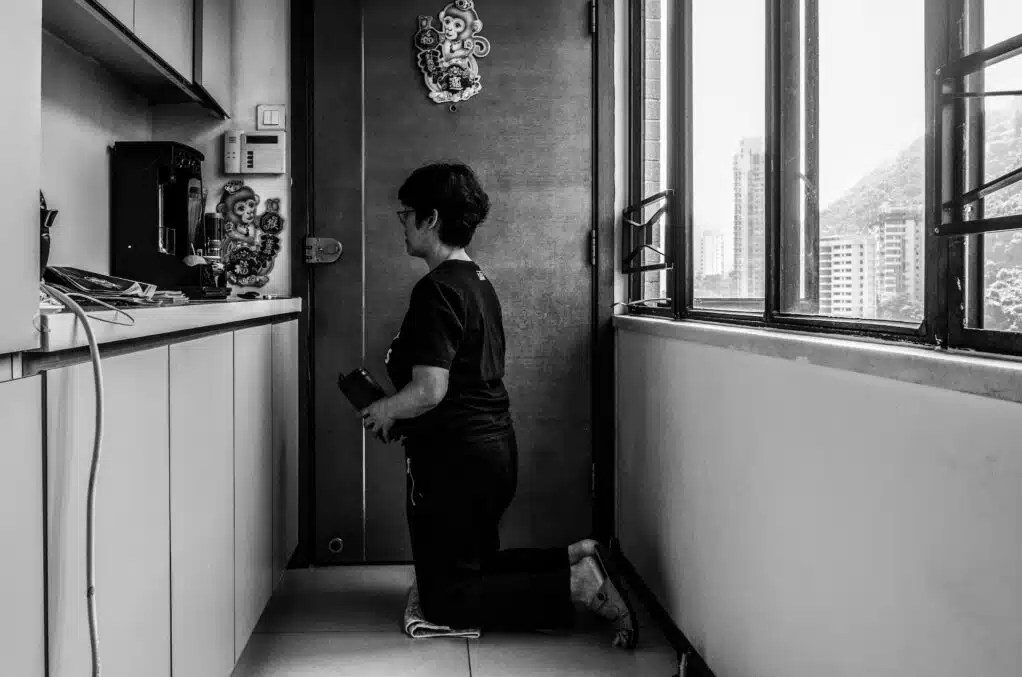
The Prayer (We Are Like Air series) 2013-2018 By Xyza Cruz Bacani
“Georgia prays to Wong Tai Sin, a Chinese deity, in Hong Kong for her Chinese employer. She is a Catholic but it is a part of her job to pray for her employer. September 15, 2018.”
Introduction
Hong Kong is well known for its riches and glistening skyscrapers that occupy the small ex british colonial territory, which was important for its deep water port and was instrumental in supplying the empire with its need for tea. Hong Kong is also known for having some of the smallest apartments in the world, with the average 2-bed being 38m², compared to London’s 67m². This not only impacts the local people of Hong Kong, who are often lead to renting extortionate subdivided apartments being as small as 13 sqm, but greatly impact the foreign domestic helpers of Hong Kong as well, who make up around 5% of the population and are usually from The Philippines or Indonesia. This article will explore the unique built environment of Hong Kong and its impacts on the foreign domestic helpers.
The live-in law
All foreign domestic helpers are required to live-in with their employer , which results in 3/5 of helpers reporting having no private room, and 1/100 reporting sleeping in kitchens, storage rooms and even bathrooms.
Because of this lack of privacy and power dynamic between employer and helper, it prompts some employers to abuse their helpers. For example there was a reported case where the employer made the helper sleep in a storage cupboard outside the entrance of the employers room, in this cupboard the employer hung drying clothes and regularly woke the helper from her sleep. The lack of sleep and humid environment caused the helper to contract tuberculosis. Another case reported that the helper was sleeping in the living room, where the male employer regularly stayed up at night to film the helper during her sleep. An additional case describes that of ‘Anushka’, who was raped by her employer during the Covid-19 pandemic, and not only suffered the huge mental load from this experience, but had to fight for justice against her employer. These cases are just a few examples of how this power dynamic between the employer and helper is worsened by the built condition, which encourages small apartments in Hong Kong, and therefore leading to more opportunity to abuse due to lack of privacy.
To support this, Professor Reeve’s study on societies without rape suggests that in societies that have diminishing resources, such as the claustrophobic apartments of Hong Kong, the male role is linked with more aggression, which can lead to higher instances of abuse. Of course the study analyses prevalence of rape in society, but it represents the greater issue of how spatial inequalities can materialize in varying levels of abuse, that include rape and mental abuse.
Little Jakarta
The foreign domestic helpers are usually given a singular day of rest on Sunday, during this day they line metro stations, plazas and other public areas. Although with little privacy, the helpers celebrate their freedom by singing, cooking and conversing with one another in temporary cardboard villages. This is evidence of how domestic helpers create a sense of belonging in their home away from home. Their Sundays are an opportunity to ‘go back home’ by conversing with other domestic workers in their mother tongue and fostering togetherness with people who have the same experiences. Although these gatherings are a highlight for the domestic workers, during this time some workers experience strangers on the street taking pictures of them during their leisure activities, one domestic worker recalls an experience,
‘I’m ashamed. Not comfortable. If we sit on the sidewalk, it’s really obvious. I’ve seen Chinese people walk on the sidewalk while taking videos and photos of us. Sometimes I run fast, afraid to be filmed. Employers must see, on TV, on the news. ‘Why are you here? What did you do?’ That’s why even on holiday, I have to be careful.’
This lack of a stable place where the community can feel comfortable and welcome can spark mental health issues, it was reported on a survey completed in 2021 that 30.8% of foreign domestic helpers suffered from depression, and 17% suffered from anxiety due to their living conditions, which include the lack of place and belonging. The quote highlights how the foreign domestic workers are ‘othered’ in Hong Kong due to their origin and social class, which is amplified by requiring the domestic workers to live-in with their employers, essentially stripping them of the possibility of integrating into society, and in a way labels the domestic workers as property, which is further worsened by the popular phrase “My filipina”, when an employer is referring to their domestic worker.
Conclusion
The city state suffers from a general lack of buildable land, which has been attempted to be levied through reclaiming land, This strategy has done little to help with land price increases and instead has destroyed natural habitats such as coral reefs, which are dying out in Hong Kong mostly due to climate change, but is being accelerated by Humans through land reclamation and overfishing. Destroying the coral reefs of Hong Kong not only impacts the vital habitats of the local area, but has a knock on effect on the wider economy, as fishermen will suffer with less catch to sell.
Although blaming simple supply and demand is easy, when looking deeper into the issue, it is clear that the problem lies in how the plots of land are sold for development. In Hong Kong land cannot be bought, it can only be leased to private developers for a set amount of time. These leases are sold to the highest bidders in auctions, causing the land prices to sky rocket. The reason why the government do this is simple; To make as much profit as possible, to then in theory be able to reinvest it back in to the country, however the private developers in order to maximize their own profits require to sell their developments at a high rate due to the initial high lease cost of the land. Naturally, the developers in order to sell more apartments will make them very small to maximize units sold per square meter. This leads to worse living conditions for the population and especially impacts the marginalized, like the foreign domestic helpers, who can suffer from lack of privacy, abuse and poor mental health due to the poor Urban condition.
-
“About Corals – Reviving Our Corals.” n.d. https://revivingourcorals.wwf.org.hk/en/about-corals/.
Ahmed, Aftar. 2022. “Societies Without Rape: Analysis of Peggy Reeves’ Study.” HCG (blog). May 23, 2022. https://www.hinducollegegazette.com/post/professor-peggy-reeves-sandy.
Civil Engineering and Development Department. n.d. “Role of reclamation in Hong Kong Development.” https://www.cedd.gov.hk/filemanager/eng/content_954/Info_Sheet3.pdf.
Cruz Bacani, Xyza. 2018. The Prayer. Photography. Photosfair Shanghai. Shanghai, China https://www.christinepark.net/usr/library/documents/main/e-catalogue-xyza-cruz-bacani_photofair-shanghai.pdf
Digital Signet. 2026. “Square Meters to Square Feet Converter.” SquareMetersToSquareFeet.Com. May 1, 2026. https://squaremeterstosquarefeet.com/apartment-sizes.
Dwyer, Chris. 2022. “A Sunday Ritual for 300,000 Women.” February 25, 2022. https://www.bbc.com/travel/article/20161109-a-sunday-ritual-for-300000-women.
Hong Kong Immigration Department. n.d. “Employment Contract for a Domestic Helper Recruited From Outside Hong Kong - English Version | Immigration Department.” Immigration Department. https://www.immd.gov.hk/eng/forms/forms/id407.html.
Huang, Wei-Jue. 2026. “Female Migrant Domestic Workers’ Social Support and Sense of Belonging Through Leisure.” Leisure Studies, January, 1–19. https://doi.org/10.1080/02614367.2026.2620796.
Hutton, Mercedes. 2024. “‘I got the justice I deserved’: Domestic worker raped by employer in Hong Kong tells of her ordeal.” Hong Kong Free Press, December 1, 2024. https://hongkongfp.com/2024/12/01/i-got-the-justice-i-deserved-domestic-worker-raped-by-employer-in-hong-kong-tells-of-her-ordeal/.
Kuo, Lily. 2022. “How Hong Kong’s ‘maid trade’ is making life worse for domestic workers throughout Asia.” Quartz, July 1, 2022. https://qz.com/176354/how-hong-kong-maid-trade-is-making-life-worse-for-domestic-workers-throughout-asia.
“Mission for Migrant Workers.” 2025. Mission for Migrant Workers. March 2025. Accessed August 23, 2026. https://www.migrants.net/_files/ugd/810759_55c24529938641da8d34c6fb8b1f379b.pdf.
Parry, Simon. 2004. “Coral Fish Stocks at Crisis Point.” South China Morning Post, January 18, 2004. https://www.scmp.com/article/441741/coral-fish-stocks-crisis-point.
Surya, Davies Christian. n.d. “Where Do Hong Kong’s Domestic Workers Sleep? 3 Personal Stories.” South China Morning Post. https://multimedia.scmp.com/infographics/news/hong-kong/article/3290257/helpers-bedtime-stories/?alichlgref=https%3A%2F%2Fmultimedia.scmp.com%2Finfographics%2Fnews%2Fhong-kong%2Farticle%2F3290257%2Fhelpers-bedtime-stories%2F.
The Chinese University of Hong Kong. 2021. “Average Monthly Rent per Square Foot for Subdivided Flats in Hong Kong ‘Shockingly’ Higher Than That for Private Housing, Survey Finds – Urban Studies.” September 2021. https://urbanstudies.cuhk.edu.hk/news/view/average-monthly-rent-per-square-foot-for-subdivided-flats-in-hong-kong-shockingly-higher-than-that-for-private-housing-survey-finds.
The National Archives. 2023. “Hong Kong and the Opium Wars - The National Archives.” December 12, 2023. https://www.nationalarchives.gov.uk/education/resources/hong-kong-and-the-opium-wars/.
The University of Hong Kong. n.d. “A Sunday Scene Only in Hong Kong – HKU CCCW.” The University of Hong Kong - Centre of Contemporary China and the World. https://cccw.hku.hk/publications/external-voices/a-sunday-scene-only-in-hong-kong/.
Yue, Ho-Yin, King-Tai Leung, and Lee-Kei Fung. 2012. “Why Housing Price in Hong Kong Is so High? An Explanation in Game Theory.” Economics and Business Letters. Vol. 3–3.
